Designing a verified checkout experience for municipal payments

Background
Paykal is a municipal payment platform used by cities and local councils across Israel to provide purchasable services such as: cultural events, facility rentals, kindergarten enrollment fees, permit applications, and more.
Its user base is diverse, ranging from residents completing a single one-time transaction to recurring users. Unlike standard e-commerce, these payments are time-sensitive and carry higher personal stakes
The project was initiated by recurring complaints from municipal admins and our support team
The Challenge
The existing checkout made no distinction between new and returning residents. Registration and identity verification followed the same flow for every purchase, requiring everyone to manually enter their full personal details each time.
Product constraints
Mandatory identification using National ID or Company ID
Guest checkout was not permitted
Resulting UX issues
Returning users had to re-enter personal details for every purchase
Authentication occurred late in the checkout flow
Personal details and payment separated into different pages
These constraints created tension between security requirements and a fast checkout experience.
My approach
Rather than redesigning the form itself, I reframed the problem as an identity handling challenge. The goal was to resolve user identity earlier in the checkout flow and avoid repeated data entry.
Step 1 — Identity Gap Analysis
Reviewed checkout behavior and recurring support complaints across municipalities. Both research and platform data pointed to the same issue: returning users had to re-enter their details on every purchase.
Step 2 – Identity Model
Introduced a lightweight ID + OTP model that:
Resolves identity before form completion
Recognizes returning users
Maintains verification standards
Avoids forced account creation
Step 3 – Flow Restructure
Separated identification from payment. Key decisions:
Early OTP verification
Conditional field exposure
clear communication of user status
Step 4 – Validation
Validated through stakeholder walkthroughs and pilot rollout. Post-launch refinements focused on OTP reliability and edge cases.
Research
Support team interviews
Conversations with the support team revealed a consistent pattern: users expected the system to recognize them. The phrase "I've already filled this in before" appeared repeatedly in support logs, exposing a clear gap between user expectations and system behavior.
Analytics review
GA4 funnel analysis showed that the checkout-to-confirmation drop-off was the primary conversion barrier. Users who reached checkout had clear purchase intent—the friction wasn't in decision-making, but in execution. The form itself was the obstacle.
Findings

Invisible Drop-Off


Late identity resolution

Coupled Authentication
Key insight
The Identity issue was resolved too late, and the system had no way to recognize returning users. The solution wasn't to redesign the form, but to introduce a lightweight identity layer that resolves user state before checkout begins.
Guiding principles
Separation
Decouple identification from registration and payment to enable flexible state handling.
Early Resolution
Identify returning users before collecting full form data to reduce redundant effort.
Usage Fit
Avoid account-heavy patterns in systems used for one-time or infrequent transactions
Exploration
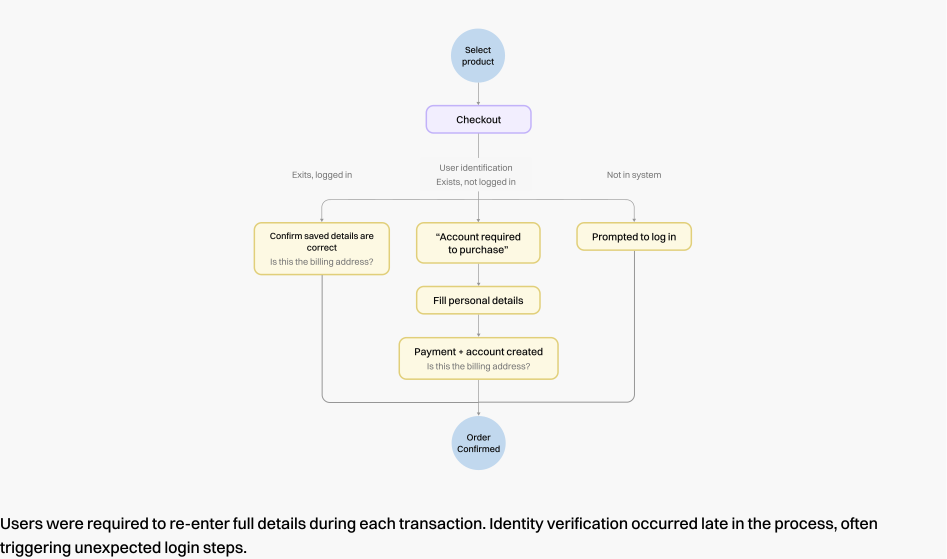
The redesign moves identity resolution to the start of checkout. Users whose ID is not found complete a one-time registration; on future purchases, their details are recalled automatically.
Checkout flow
Deliverables
The redesign focused on a single structural shift: moving identity resolution before the form, so the system could adapt to the user rather than the user adapting to the system. Every decision, from progressive disclosure to the side panel OTP, followed from that principle.
Before and after


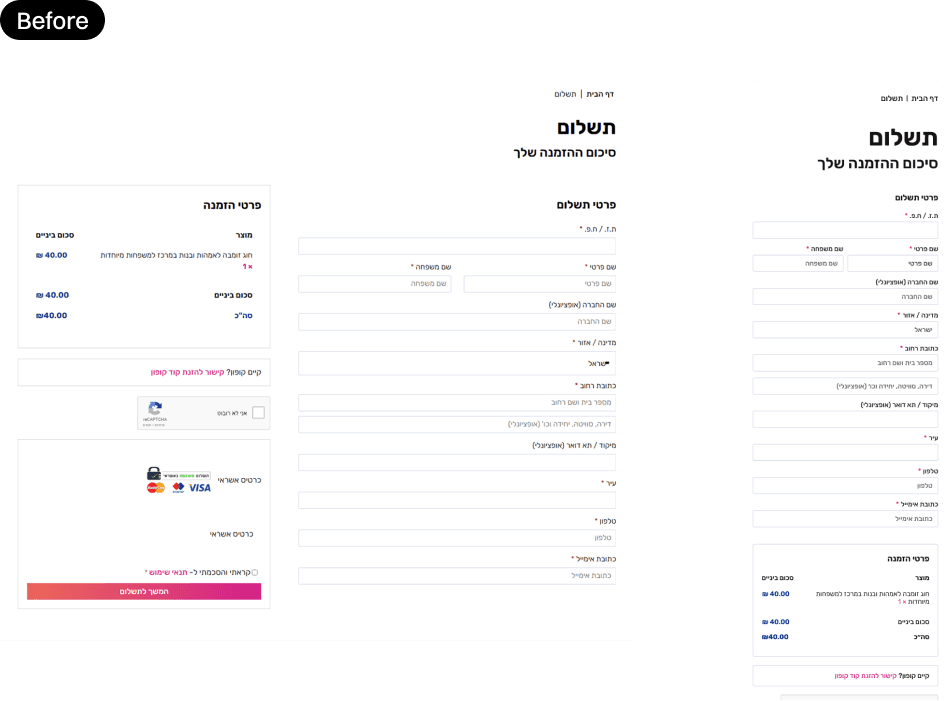

Additional improvements made in the same release:
Product images in the order summary
Cart editing enabled from the checkout page
The new identity step
Before reaching the form, users now enter their National ID or Company ID. This single field determines the entire experience: returning users are recognized and their details pre-filled; new users complete a one-time registration that saves their details for future purchases.
New visitors / first time purchase

First-time users complete a one-time registration; their details are saved and auto-filled in future purchases.
Impact
Performance was evaluated by comparing the same six-month window (January–June) across two consecutive years.
The new version was released in late 2024 and is currently live across 90 municipalities.
85.8%
up from 84.5%
Checkout completion rate, comparing the same six-month period across consecutive years.
Checkout traffic grew 9.9% over the same period, while completed orders increased 12%. To account for traffic growth, I use checkout completion rate as the primary outcome metric.
Context
Checkout visitors
2,268 → 2,493 (+9.9%)
Completed orders
1,911 → 2,140 (+12%)
Drop-offs
357 → 353
Data sources
Google Analytics, external payment system
© 2026 Michal Oring